

Bespoke Acrylic Display Case Dimensions: A Complete Guide
Table of Contents
- Understanding Acrylic Display Case Dimensions
- How to Measure for a Custom Display Case
- Acrylic Display Case Thickness Guide
- Base Options and Their Impact on Overall Dimensions
- Customisation Options for Bespoke Acrylic Display Cases
- Bespoke Acrylic Display Case Lead Times and Ordering
- Common Mistakes When Specifying Display Case Dimensions
- Frequently Asked Questions
Last Updated: September 25, 2026
Understanding Acrylic Display Case Dimensions
When you're sourcing a bespoke acrylic display case, dimensions are everything. Get them wrong and your collectible sits loose inside a box that's too large, or worse, you can't fit the item at all. The difference between a poorly specified case and a properly designed one comes down to precision in measurement and understanding how external versus internal dimensions work together.

At Acrylic Display uk, we've spent over 30 years helping retailers, museums, and collectors specify display cases that protect their most valuable pieces. The most common mistake we see is customers confusing internal and external measurements, or forgetting to account for clearance space around their items. Both lead to costly remakes.
External vs Internal Dimensions
External dimensions define the overall footprint of your display case, the total width, depth, and height as it sits on a shelf or floor. Internal dimensions are the usable space inside where your item actually goes. The difference between these two measurements depends on material thickness and base height.
For a standard acrylic display cube with 3mm panel thickness, the internal space is roughly 6mm smaller in each direction than the external measurements. If you specify a case that's 300mm external on all sides, expect approximately 294mm of internal width and depth. Base height typically ranges from 15mm to 25mm, which reduces your internal vertical space accordingly.
Understanding this distinction matters because it directly affects how much clearance you have around your collectible. A boxing belt display case, for example, needs enough internal height to accommodate the belt's width plus mounting hardware, plus breathing room so the item doesn't touch the acrylic walls.
Why Precision Matters for Your Display
Tolerance and clearance aren't abstract concepts, they're the difference between a display that looks professional and one that looks cramped or unsafe. When you leave insufficient clearance around an item, acrylic can press against it during temperature changes, potentially causing damage. When you leave too much space, the item appears to float awkwardly inside the case, undermining the premium presentation you've paid for.
If you're ordering multiple units for a chain rollout, consistent dimensions across all cases become critical for brand appearance.
How to Measure for a Custom Display Case
The measurement process determines everything that follows. Take time here, and your fabrication will be straightforward. Rush it, and you'll either have a case that doesn't fit your item or one that requires expensive rework.
Measuring Your Item Accurately
Start by measuring your collectible in three dimensions: width, depth, and height. Use a steel tape measure or callipers for precision, soft measuring tapes stretch and introduce error. Measure the widest point of your item in each direction, not the narrowest. If your memorabilia has protruding elements (a figurine's outstretched arm, a belt's buckle), those define your actual space requirement.
Write down measurements in millimetres. If your item is 280mm wide at its widest point, note that specifically. Round up rather than down, a case that's slightly larger is always preferable to one that's too tight.
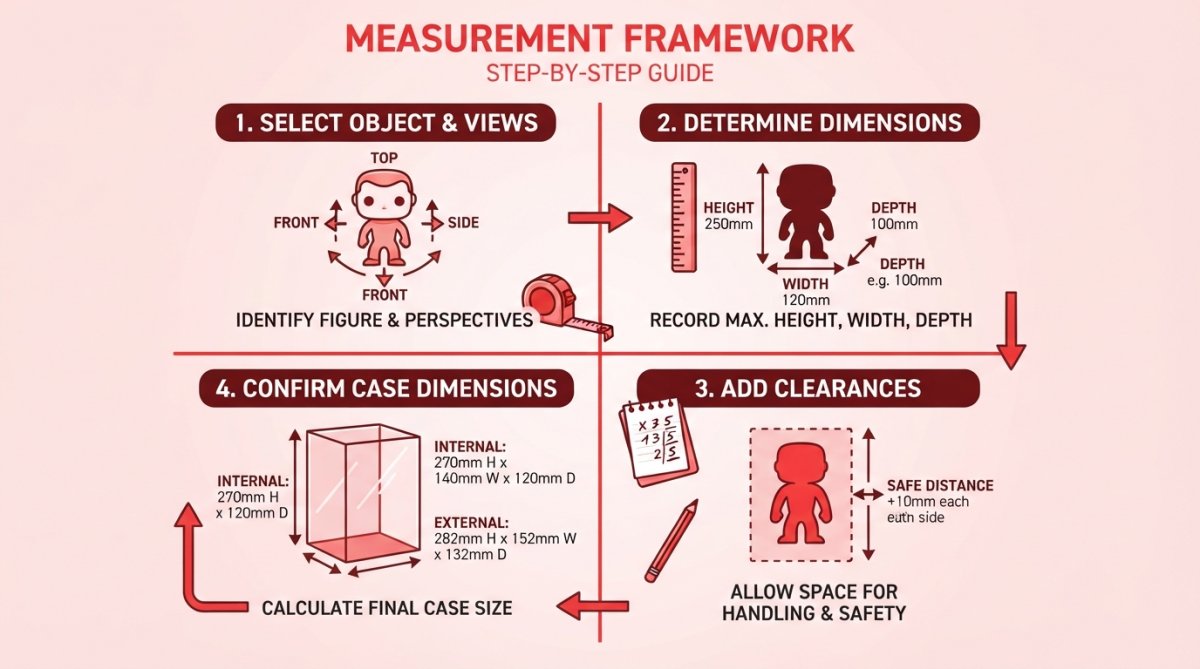
For irregularly shaped items, measure at multiple points.
Accounting for Clearance and Tolerance
Once you have your item's actual dimensions, add clearance space. A standard guideline is 20-30mm clearance on all sides for items under 500mm, depending on how precious the piece is and how prominent you want it to appear. High-value memorabilia often benefits from slightly more breathing room, it signals care and protection.
Acrylic Display Case Thickness Guide
Material thickness directly affects structural integrity, optical clarity, and cost. Thicker isn't always better, it depends on your use case, the size of the case, and the weight of what you're displaying.
Panel Thickness and Structural Integrity
Standard acrylic thickness options are 3mm and 5mm. For cases up to 300mm in any direction, 3mm acrylic provides adequate rigidity and optical clarity. The material transmits light beautifully at this thickness without yellowing or cloudiness in normal indoor conditions.
Perspex vs Acrylic: Material Specifications
Perspex and acrylic are often used interchangeably, but they're technically the same material, polymethyl methacrylate (PMMA). The distinction in the UK market is largely brand-based. Perspex is the trade name for acrylic made by Lucite International; other manufacturers produce acrylic under different brand names. Performance characteristics are nearly identical.
Base Options and Their Impact on Overall Dimensions
The base is more than aesthetic, it's a structural component that affects your overall case height and stability. Base choice influences how your case sits on a shelf or floor and contributes to the finished appearance.
Base Finishes and Heights
Bases are typically 15mm to 25mm high, depending on the design. A simple raised base (15mm) provides minimal height but enough to separate the acrylic cube from the surface below, allowing light to pass underneath for a floating effect. This works well for tabletop displays where you want the item to appear elevated.
Details about Acrylic Display Case for →
Freestanding vs Tabletop Configurations
For retail rollouts across multiple locations, consistency in base configuration is important. If you're deploying 50+ cases across a chain, ensure all units have the same base height and finish so they present a unified brand appearance.
Customisation Options for Bespoke Acrylic Display Cases
Beyond dimensions and thickness, customisation options allow you to tailor cases to specific brand and functional requirements. These choices affect both aesthetics and performance.
Polished Edges and Finish Choices
Polished edges are standard on quality bespoke cases. They eliminate sharp edges, improve optical clarity at the perimeter, and signal craftsmanship. All edges on Acrylic Display uk's products are hand-polished, which removes tool marks and creates a smooth, professional finish.
UV Protection and Light Transmission
UV-stabilised acrylic is non-negotiable for displays in sunlit spaces or under halogen lighting. Standard UV-stabilised acrylic protects your collectible from fading and discoloration. This is particularly important for textiles, artwork, and memorabilia with colour-sensitive materials.
Bespoke Acrylic Display Case Lead Times and Ordering
Lead times depend on complexity, order volume, and current production capacity. Understanding the timeline helps you plan retail launches and inventory rollouts effectively.
From Specification to Delivery
Rush orders are possible, contact Acrylic Display uk directly to discuss timeline options for urgent requirements.
Bulk Orders and Consistency Across Multiple Units
For retail rollouts requiring 20+ units, consistency becomes the primary concern. All cases must match in dimensions, finish, and appearance to maintain brand integrity across locations. Acrylic Display uk manufactures bulk orders from a single specification, ensuring uniformity across all units.
Common Mistakes When Specifying Display Case Dimensions
The most frequent errors fall into a few categories. Recognising these helps you avoid costly remakes.
Frequently Asked Questions
How do I measure an item for a bespoke acrylic display case?
Measure your item in three dimensions: width, depth, and height in millimetres. Use a rigid ruler or tape measure and note the highest, widest and deepest points. Then add 10-20mm clearance on each side depending on how snugly you want the item to fit. Measure twice to avoid costly errors. Most manufacturers, including those with 30+ years of experience, recommend providing both your item dimensions and your preferred case dimensions for accuracy.
What thickness should my bespoke acrylic display case be?
Standard thickness ranges from 3mm for small cases (up to 300mm) to 5mm for larger displays. Polished edges are standard, and UV-stabilised material prevents yellowing over time, keeping your display clear for years.
What is the difference between internal and external dimensions?
External dimensions are the overall size of your finished display case from outside edge to edge. Internal dimensions account for the panel thickness and determine how much space your item actually has inside. For example, a case with 350mm external width and 3mm-thick panels has roughly 344mm of internal width. Always specify which you're measuring to avoid misunderstandings with your manufacturer.
How long does it take to receive a bespoke acrylic display case?
Lead times vary based on complexity and order volume. Bulk orders across multiple locations may take longer depending on quantities, but manufacturers with UK factory operations and modern machinery can often accommodate large rollouts without compromising quality. Contact your supplier directly for an instant quote and specific timescale for your requirements.
Should I add clearance to my display case dimensions?
Yes. Adding 10-20mm of clearance around your item prevents damage during assembly and allows for slight variations in manufacturing. This is especially important for irregular shapes or delicate collectibles. Tolerance guidelines vary by item type: fragile masks and figures benefit from more clearance, while tight-fitting items like sports memorabilia may need less. Discuss clearance requirements with your manufacturer when specifying dimensions.
Can bespoke acrylic cases be made for irregular shaped items?
Yes, most manufacturers offer bespoke fabrication for non-standard shapes. Provide detailed measurements of the widest, deepest, and highest points of your item, plus any internal stand or support requirements. Custom configurations can include removable shelves, internal stands, or specialised bases. For complex shapes, supplying a photo or sample can help your manufacturer create the perfect fit.
What are the benefits of bespoke dimensions over standard sizes?
Bespoke cases eliminate wasted space, provide a custom fit that protects your items better, and maintain brand consistency across multiple locations. Standard sizes often leave awkward gaps or require your item to be cramped. With made-to-measure cases, you control every dimension, base finish, and customisation option, ensuring your display looks professional and your collectibles stay protected.
How do base options affect the overall height of my display case?
Bases typically add to the overall height, depending on style and finish. Specify your preferred base height and material when ordering to ensure your final dimensions match your display space.