

Acrylic Display Case Bulk Order Lead Times
Table of Contents
- How Bulk Lead Times Break Down: From Order to Dispatch
- The Bespoke Acrylic Display Manufacturing Process, Stage by Stage
- Custom Acrylic Display Case Lead Time Factors That Change Your Date
- Minimum Order Quantities for Acrylic Displays and Scalability Tiers
- Standard and Express Delivery Options for Bulk Orders
- What Supply Chain Transparency Should Look Like on a Bulk Quote
- Frequently Asked Questions
Last Updated: September 10, 2026
How Bulk Lead Times Break Down: From Order to Dispatch
Bulk order lead times for acrylic display cases run from a few working days for standard stock to several weeks for bespoke runs, depending on quantity, customisation and the manufacturing queue. At Acrylic Display uk, a family-run manufacturer with over 30 years of experience producing acrylic and Perspex displays, buyers who understand the production stages plan realistic launch dates; those who treat lead time as a single number end up chasing their supplier.
The most common mistake is assuming a bulk order is just a bigger single-unit order. Volume changes how an order moves through a workshop.
Here's how the timeline actually breaks down:
- Enquiry and quotation - dimensions, quantities, finishes and any branding are confirmed, and a lead-time estimate is issued.
- Order confirmation and deposit - your order joins the manufacturing queue at this point, not before.
- Material sourcing - acrylic sheet in the required thickness and finish is allocated or ordered in.
- Cutting and fabrication - panels are cut, edges are finished and any drilling or bending takes place.
- Assembly and quality check - cases are assembled, cleaned and inspected.
- Packing and dispatch - items are wrapped, boxed and handed to the parcel or freight service.
The Bespoke Acrylic Display Manufacturing Process, Stage by Stage
Bespoke acrylic display manufacturing means producing display cases to your own dimensions, finish and branding rather than picking from a catalogue. That matters for lead times because nothing is pulled from a shelf.
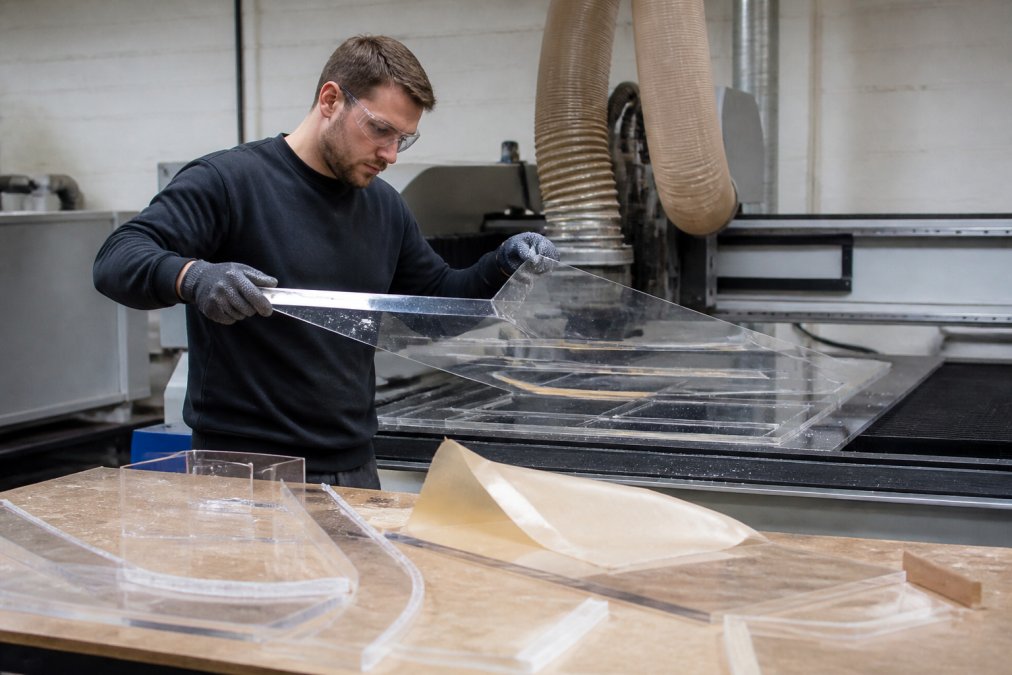
Material Sourcing, Cutting and Flame Polishing
Material sourcing is usually the first hidden delay. Clear acrylic sheet is stocked in common thicknesses, but an unusual thickness or specialist finish may need to be brought in, adding time before a single cut is made.
Cutting is where most of the precision work happens. Panels are cut to size, then edges are prepared. Flame polishing separates a professional-looking display from a rough one: the cut edge is heated so the surface melts and re-forms into a clear, glass-like finish (PubMed). Glued edges are joined and left to cure, which cannot be rushed without risking cloudy joints.
The polishing and curing stages don't compress well. A rushed flame-polished edge shows under retail lighting, and an under-cured joint hazes over time.
Custom Acrylic Display Case Lead Time Factors That Change Your Date
Custom acrylic display case lead time factors fall into four groups: quantity, complexity, finish and timing. Twenty identical standard cases move through the workshop far faster than 20 cases in five configurations.
The factors that most often push a date back:
- Order quantity - a larger run takes longer to cut, polish, assemble and inspect, even when the design is identical.
- Custom size and made to measure work - every non-standard dimension needs its own cutting setup.
- Finish specification - flame polished, glued edges, UV-stabilised sheet and branded engraving all add handling steps.
- Order cut-off timing - an order confirmed late on a Friday effectively starts the following working week.
- Manufacturing queue position - during peak retail rollout periods, the queue is simply longer.
A practical rule: the more your order deviates from a repeatable, identical unit, the more you should build into your delivery estimate. Multi-site rollout buyers should standardise dimensions wherever possible.
Minimum Order Quantities for Acrylic Displays and Scalability Tiers
Minimum order quantities for acrylic displays depend on how far the design sits from a standard product. Off-the-shelf display cases can often be ordered in small numbers, while fully bespoke fabrication carries a higher minimum because setting up a run for a handful of units isn't efficient.
The more useful question for a bulk buyer is not "what is your MOQ?" but "what does lead time look like at 10, 50 and 100+ units?" Most suppliers answer the first and dodge the second. Here's how the tiers behave at a workshop running its own cutting, polishing and assembly.
| Tier | Typical Order Size | Production Approach | Indicative Lead Time (from confirmed order) |
|---|---|---|---|
| Sample / trial | 1-5 units | Standard or lightly customised | 3-7 working days |
| Small bulk | 10-25 units | Repeatable bespoke run, single batch | 2-3 weeks |
| Mid-volume rollout | 25-50 units | Repeatable bespoke run, may split into 2 batches | 3-5 weeks |
| Large rollout | 50-100+ units | Staged bespoke production, phased dispatch | 5-8 weeks, split into phases |
These ranges assume a single, identical specification. Introduce variation, different sizes per site, mixed finishes, engraved branding on some units only, and you move from a repeatable run into a series of small bespoke runs, compounding lead time.
Why larger runs don't scale linearly
A common assumption is that 100 units takes ten times as long as 10. It doesn't, but it also doesn't take the same time. Cutting and polishing can be batched, which is where the efficiency comes from. Assembly, quality inspection and packing don't compress, every unit is handled, checked and wrapped individually, which on a 100-unit run can account for several working days.
There's also a queue effect: a 100-unit order occupies a production slot longer, so it sits in the schedule differently from a 10-unit order. Confirm a large run during peak retail fit-out and you're competing for the same slot as every other rollout manager.
Phased scheduling: getting the first sites live sooner
For a multi-site rollout, splitting a large order into two or three production batches is usually right. The first batch ships while the second is still in production, so your earliest sites go live weeks sooner. The trade-off is administrative: agree batch sizes, dispatch dates and a consistent specification up front, because a change between batches means re-tooling and a new queue position.
A practical pattern is a 30/40/30 split, enough in the first batch for your flagship or highest-traffic sites, with the rest following in two waves. Discuss this at quotation stage; batch scheduling is a planning decision, not a production adjustment.
The scalability question that actually matters
The question worth asking is not "can you make 50?" but "can you make 50 without quality dropping on unit 47?" A manufacturer with its own machinery has an advantage over a reseller passing work to a third party: the same team that made your sample makes your final batch, using the same jigs, polishing setup and inspection standard. Consistency across a batch is a production discipline, not a promise.
If you're planning a rollout across many locations, standardise dimensions wherever possible. A single repeatable specification is the difference between a 3-week lead time and a 6-week one.
Standard and Express Delivery Options for Bulk Orders
Standard and express delivery options for bulk acrylic orders differ mainly in how goods leave the workshop, not how fast they're made. Express delivery shortens transit, not the manufacturing queue, the most important distinction before you promise a launch date.
Standard shipping uses a parcel service for smaller consignments and palletised freight for bulk orders. Express delivery suits time-critical launches where production is complete and only transit is under pressure. For 100 units, express parcel isn't realistic, you're into freight, which has its own booking lead times.
What matters for planning:
- Dispatch time is when the goods leave the workshop; delivery estimates are counted from there.
- Order processing and production happen before dispatch, so express shipping cannot rescue a late order confirmation.
- Collection is often the fastest option if you have your own transport or a local courier.
- Business days exclude weekends and public holidays, which catches out buyers counting calendar days.
How to actually expedite a bulk order
If you need a large order sooner than the standard lead time allows, four levers genuinely work, and one doesn't.
1. Split the order into a fast batch and a standard batch. Ask for the first 10-20 units on an expedited production slot, with the remainder on the normal schedule. This gets your first sites or event live on time without rushing the entire run, the single most effective expediting method for bulk orders, and rarely offered unless you ask.
2. Standardise the specification. Every variation, a different size, finish, or engraved branding on a subset, adds a setup step. One identical specification across the run removes those steps and moves the order faster. If you need variation, isolate it to a few units rather than spreading it across the batch.
3. Confirm everything before the order enters the queue. Artwork, dimensions, finish and hardware (locks, hinges, shelf counts) must be locked at confirmation. A change after cutting means new material and a new queue position, not a quick edit. This is the most common cause of missed dates, and it's entirely within your control.
4. Book freight early for palletised consignments. For 50+ units you're likely shipping on pallets, and freight needs booking in advance. A run finishing Friday but not collected until Wednesday has lost three working days to logistics, not manufacturing.
What doesn't work is asking for express shipping on an order that hasn't been confirmed. Transit speed is the last variable in the chain, and it's the one with the least leverage over your actual delivery date.
Matching the delivery method to the order size
For 1-10 units, a parcel service is usually fine and collection is often fastest. For 10-50 units you're at the boundary, multiple parcels or a single pallet. For 50+ units, assume palletised freight and plan for a delivery window, since freight is booked as a day slot, not an hour slot (gov.uk).
If your sites can't accept pallet deliveries, no loading bay, no forklift, restricted access, say so at quotation stage. A pallet that can't be delivered is returned and rebooked, adding days. Tail-lift delivery or a split into manageable consignments solves this, but only if arranged before dispatch.
For multi-site rollouts, agree a dispatch schedule alongside the production schedule: which batch goes where, on which date, by which method. That turns delivery from a single unknown into planned events you can build a launch calendar around.
What Supply Chain Transparency Should Look Like on a Bulk Quote
Supply chain transparency on a bulk quote means you can see where each stage sits and which one is the constraint. A good quote gives the material sourcing position, production slot and dispatch method, not just a single lead-time figure.
Ask for these four things on any bulk quote:
- A breakdown by stage - material, production, finishing, packing, dispatch.
- The order cut-off that applies to your quoted date.
- The dispatch method and parcel or freight service being used.
- A named contact for the order, so changes and queries don't disappear into a general inbox.
This is where buyers get caught out. A quote saying "3-4 weeks" without stating whether that's working days, whether it includes delivery, or what happens if material is delayed isn't a quote, it's an estimate dressed up as a commitment.
For high-value items, transparency also covers protection in transit. Our display cases are quality checked and carefully packed before dispatch, which matters when shipping glass-look acrylic cabinets or lockable display cabinets with removable shelves to multiple sites.

UV-stabilised acrylic holds its clarity far better than non-stabilised sheet, the difference between a case that still looks clean after a year and one that has yellowed (PubMed). If your displays hold high-value collectibles, that specification belongs in the quote.
Before committing to a bulk run, order a sample unit. Review the finish, edges and clarity on a single case, then scale the same specification across your rollout knowing every unit will match. Browse the range at Display Cabinet 5mm Perspex Acrylic Lock 2 Keys & Removable Shelves Choices or the glass look acrylic cabinet with cam lock to see the finish a bulk order would replicate.

For buyers who need to align a rollout with a brand standard, the curved clear acrylic cabinet with individual hinged doors shows how a bespoke shape can still be produced repeatably across a batch.

Bulk acrylic orders reward planning more than speed. Buyers who hit launch dates confirm dimensions early, standardise where they can, and ask for a staged production schedule instead of a single delivery date.
Acrylic Display uk manufactures every order in its own UK factory, with bespoke display manufacturing, custom sizes and quality-checked packing handled in-house. Get started with Acrylic Display uk and build a bulk order timeline you can actually plan a launch around.
Frequently Asked Questions
How long does it take to manufacture bulk acrylic display cases?
Most bulk orders move through cutting, edge polishing, assembly and quality checking in a matter of working days rather than weeks. A run of standard display cabinets, such as the 5mm Perspex lockable cabinet at £133.92, is quicker than a fully bespoke build because no new tooling is needed. Add time for material sourcing if you specify a non-standard acrylic thickness, and allow extra days for flame polishing and glued edges on larger panels. Your exact dispatch date is confirmed once artwork, dimensions and quantity are locked.
Can I expedite a bulk order for acrylic display cases?
Express delivery is possible on many bulk runs, but it depends on where your order sits in the manufacturing queue. The fastest route is to pick a catalogue size, confirm the order before the daily cut-off and accept standard flame polished edges rather than a bespoke finish. If you need a custom size, ask for an expedited slot at the quote stage so the production team can reserve capacity. Freight shipping and parcel service options can also be upgraded separately from production time.
What is the minimum order quantity for bulk acrylic displays?
There is no single figure, because minimum order quantities for acrylic displays depend on the product. Catalogue items can be ordered in small numbers, while bespoke fabrication usually needs a higher volume to justify setting up a production run. If you are rolling out displays across multiple retail sites, ask for a scalability tier quote: the price per unit and the turnaround time often improve as quantity rises. This is also the point to raise bulk inquiry terms and any collection arrangements.
Do custom sizes and finishes add to the lead time?
Yes. Made to measure work adds time because each panel is cut, glued and flame polished individually rather than pulled from a standard batch. Factors that push the date out include unusual acrylic thickness, complex shapes, UV stabilised material, lock or cam lock fitting, and removable shelves. Supplying accurate product dimensions with your enquiry removes the back-and-forth that causes most delays. If your deadline is fixed, confirm the custom size early and keep the finish specification simple.