

Why Polished Acrylic Edges Matter
Table of Contents
- Why Polished Acrylic Edges Matter for Display Quality
- How Polished Edges Improve Optical Clarity and Light Transmission
- Durability and Edge Integrity: What Polishing Achieves
- Flame Polishing vs Diamond Polishing: Which Method Works Best
- How to Smooth Perspex Edges: Professional and DIY Approaches
- Maintenance and Repair of Polished Edges
- Real-World Applications: Where Edge Finish Makes a Difference
- Frequently Asked Questions
Last Updated: September 30, 2026
Why Polished Acrylic Edges Matter for Display Quality
Polished acrylic edges are the difference between a display that looks premium and one that looks rushed. When you view acrylic through an unpolished edge, light scatters. The edge appears cloudy, frosted, or yellowed. A polished edge transmits light cleanly, revealing the crystal-clear material beneath and creating the visual impression of floating products.
This matters because edge quality signals craftsmanship to your customers. Retail displays with rough edges suggest cost-cutting. Polished edges suggest investment in quality. For museum cases, memorabilia displays, and retail installations, the edge finish is often the first thing viewers notice, and it shapes their perception of everything inside.
At Acrylic Display uk, we've spent over 30 years manufacturing displays where edge quality directly impacts how customers perceive the product on display. Whether you're launching a high-value collectible case or rolling out POS displays across multiple locations, the edge finish determines whether your display looks like a premium solution or a budget alternative.

The reason polished acrylic edges matter comes down to three factors: optical clarity, durability, and aesthetics. Each one influences whether your display performs the job you need it to do.
How Polished Edges Improve Optical Clarity and Light Transmission
A polished acrylic edge transmits light without scattering it. Unpolished edges refract light in random directions, creating a frosted or cloudy appearance that obscures the material's transparency. This is why museum cases with polished edges allow visitors to see artifacts clearly from every angle, while rough edges create visual noise.
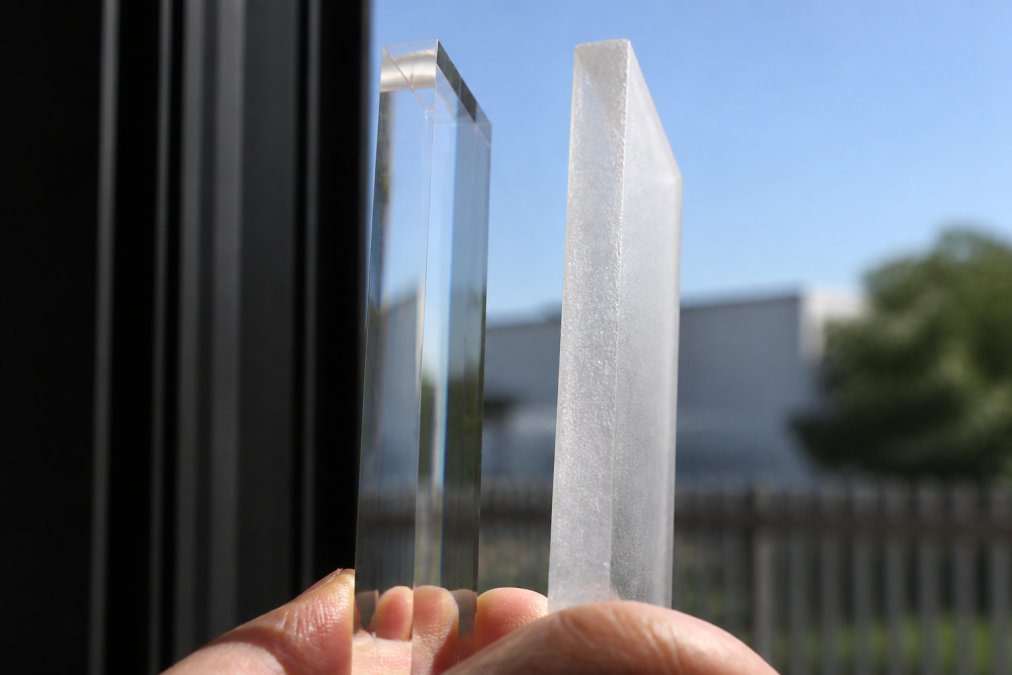
The optical difference between polished and unpolished edges comes from surface smoothness. When acrylic is cut, the cut edge has microscopic peaks and valleys. Light bounces off these irregularities instead of passing straight through. Polishing removes these peaks, creating a smooth surface where light travels in a straight path. The result is high-visibility display cases where the product, not the case, is the focus.
For retail displays, this clarity matters because customers judge products based on how they're presented. A polished edge makes acrylic nearly invisible, creating the illusion that products are floating. Unpolished edges draw attention to the material itself, which undermines the display's purpose. When you're displaying jewellery, collectibles, or branded merchandise, the last thing you want is a cloudy edge competing for attention.
The refractive index of acrylic is 1.49, meaning light bends slightly as it passes through the material. A polished edge minimizes this effect by ensuring light enters and exits the acrylic cleanly. This is why high-end retail and museum installations prioritize polished edges, they preserve the optical integrity of the display.
Durability and Edge Integrity: What Polishing Achieves
Polished edges are more durable than rough ones, but the reason lies in stress distribution and material science. When acrylic is cut, the cut edge is left with microscopic stress concentrations, peaks, valleys, and micro-fractures where the material is weakest. These stress points act as crack initiation sites. Under mechanical load, thermal cycling, or impact, cracks propagate from these weak points, leading to edge chipping, splitting, or catastrophic failure.
Polishing removes the stress concentrators by smoothing the surface to a near-atomic level. This redistribution of surface stress means that applied force is spread evenly across the edge rather than concentrated at micro-defects. The result is measurably higher resistance to impact, bending stress, and thermal shock.
Crack propagation and thermal cycling: Acrylic expands and contracts with temperature changes (linear expansion coefficient approximately 70 × 10⁻⁶ per °C). Unpolished edges, with their stress points, are prone to microcracking during thermal cycles because stress concentrates at the peaks and valleys. Polished edges distribute this thermal stress evenly, significantly reducing the risk of failure in environments with temperature fluctuations, a critical consideration for displays in retail spaces with HVAC systems or near windows.
Impact resistance: A polished edge can withstand shipping impacts, handling, and accidental contact without chipping. Rough edges fail at lower impact thresholds because the stress concentrators amplify the force locally. For displays in high-traffic retail environments or those that require frequent repositioning, polished edges reduce replacement costs and downtime.
Surface degradation and moisture ingress: Rough edges trap moisture and dust in their microscopic valleys. Over time, moisture penetration can cause stress corrosion cracking, a process where water molecules weaken the polymer chains at the edge. Polished edges, being smooth, resist moisture ingress and are easier to clean, preventing the accumulation of contaminants that accelerate degradation. This is why museum-quality displays prioritise polished edges for long-term preservation.
Edge durability in cast vs. extruded acrylic: Cast acrylic, which is poured and cured in moulds, has a more uniform molecular structure than extruded acrylic (which is forced through dies under pressure). Cast acrylic edges respond better to polishing because the material is more homogeneous; polishing removes surface stress without introducing new internal stresses. Extruded acrylic, being slightly more oriented, can sometimes show minor stress relief after polishing, but the durability gain is still substantial. Professional polishers account for this difference by adjusting pressure and grit progression.
For high-value displays or installations expected to last 10+ years, the durability advantage of polished edges justifies the additional fabrication cost. The edge finish directly correlates with the display's lifespan and resistance to environmental stress.
Cubes Plinth Acrylic Display Clear →
Flame Polishing vs Diamond Polishing: Which Method Works Best
Two primary methods create polished acrylic edges: flame polishing and diamond polishing. Each produces different results and suits different applications.
Flame polishing uses a controlled flame to melt the surface of the acrylic edge, smoothing it. The heat softens the acrylic, and the surface tension creates a glossy finish. This method is fast and cost-effective, but it has limitations. Flame polishing can introduce stress into the material if heat is applied unevenly. It also works best on thinner acrylic sheets (up to 3mm). For thicker material, the heat may not penetrate evenly, leaving the edge unpolished in places.
Diamond polishing uses a series of diamond-grit tools to gradually smooth the edge, similar to sanding but with much finer abrasives. This method is slower but more precise. It works on all acrylic thicknesses and produces a consistently smooth, crystal-clear edge. Diamond polishing also avoids the risk of thermal stress because no heat is applied. The result is an edge that's both optically clear and structurally sound.
For retail displays and museum cases, diamond polishing is the preferred method. It delivers superior edge quality, especially for thicker acrylic (5mm and above). Flame polishing works well for thin, budget-conscious applications, but it carries a higher risk of edge degradation over time.
Acrylic Display uk uses diamond polishing on all bespoke display cases and higher-specification products, including our Boxing Belt Display Case, which features polished crystal-clear acrylic edges designed to showcase high-value collectibles without distortion.

How to Smooth Perspex Edges: Professional and DIY Approaches
Edge polishing can be achieved through professional equipment or DIY methods, but the quality, speed, and risk profile differ significantly. Understanding the technical differences helps you choose the right approach for your project.
Professional diamond polishing equipment: Industrial CNC diamond polishing systems use a series of diamond-grit wheels (typically progressing from 60-grit through 400-grit, finishing with 1000-grit or higher) mounted on automated arms. The equipment maintains consistent pressure, speed, and angle across the entire edge, producing optically clear results in a single pass. Professional polishers can process edges at 2-5 metres per minute, depending on acrylic thickness and desired finish. The diamond grit is bonded to resin or metal wheels, which are replaced as they wear, ensuring consistent abrasive performance. This method works on all acrylic thicknesses (1mm to 50mm+) and produces edges suitable for museum-quality displays. The cost is higher, but the consistency and speed make it economical for production runs of 10+ units.
Manual diamond polishing for small fabricators: Small workshops and fabricators can use handheld diamond polishing pads (available in 60, 120, 220, 400, 600, 1000, and 3000-grit grades) attached to orbital sanders or angle grinders. This approach requires skill to maintain even pressure and avoid overheating the acrylic. The process is slower (typically 30-60 minutes for a 1-metre edge on 5mm acrylic) and the results depend heavily on operator technique. However, for bespoke one-off pieces or repairs, manual diamond polishing offers precision control and avoids the capital investment of CNC equipment. The key is to progress through grits systematically, skipping grits leaves scratches that must be removed by the next finer grit, wasting time and material.
Flame polishing: A controlled flame (typically oxy-acetylene or propane) is passed over the edge to melt the surface slightly, smoothing it.
Maintenance and Repair of Polished Edges
Polished acrylic edges require minimal maintenance but benefit from proper care. The edge finish is durable, but it can be damaged by rough handling or incorrect cleaning.
Real-World Applications: Where Edge Finish Makes a Difference
Polished acrylic edges are essential in several industries where display quality directly impacts customer perception.
Frequently Asked Questions
How do you polish acrylic edges to achieve a high shine?
Professional polishing uses either flame polishing or diamond polishing techniques. Flame polishing applies controlled heat to melt and smooth the surface, while diamond polishing uses fine abrasive pads to buff the edge. Both methods require specialist equipment. Polished acrylic edges achieve optical clarity and a crystal-clear finish that rough edges cannot match. Professional manufacturers use these methods to ensure display-quality results.
What is the difference between flame polishing and diamond polishing acrylic?
Flame polishing uses heat to melt the acrylic surface, creating a seamless, glossy finish with excellent optical clarity. Diamond polishing uses progressively finer abrasive pads to buff the edge smooth. Flame polishing is faster, while diamond polishing offers more control over edge thickness and works well for cast acrylic. The choice depends on material type and desired finish quality.
Can you polish Perspex edges at home, or is professional equipment required?
Home polishing of Perspex is possible using fine sandpaper or sanding pads, but results are limited compared to professional methods. DIY sanding can smooth rough edges but rarely achieves the crystal-clear, high-visibility finish that flame or diamond polishing delivers. Professional equipment provides consistent results across large batches, essential for retail displays and memorabilia cases. Most users find professional polishing worthwhile for quality-critical applications.
Why do rough acrylic edges affect the overall appearance of a display?
Rough edges scatter light and reduce optical clarity, making displays appear less premium and affecting how light transmits through the acrylic. Unpolished edges also attract dust and debris more readily, requiring frequent cleaning. Polished edges maintain high-visibility and aesthetic appeal, crucial for retail displays, museum cases, and collector memorabilia. The difference between a polished and rough edge is immediately visible and significantly impacts perceived quality.